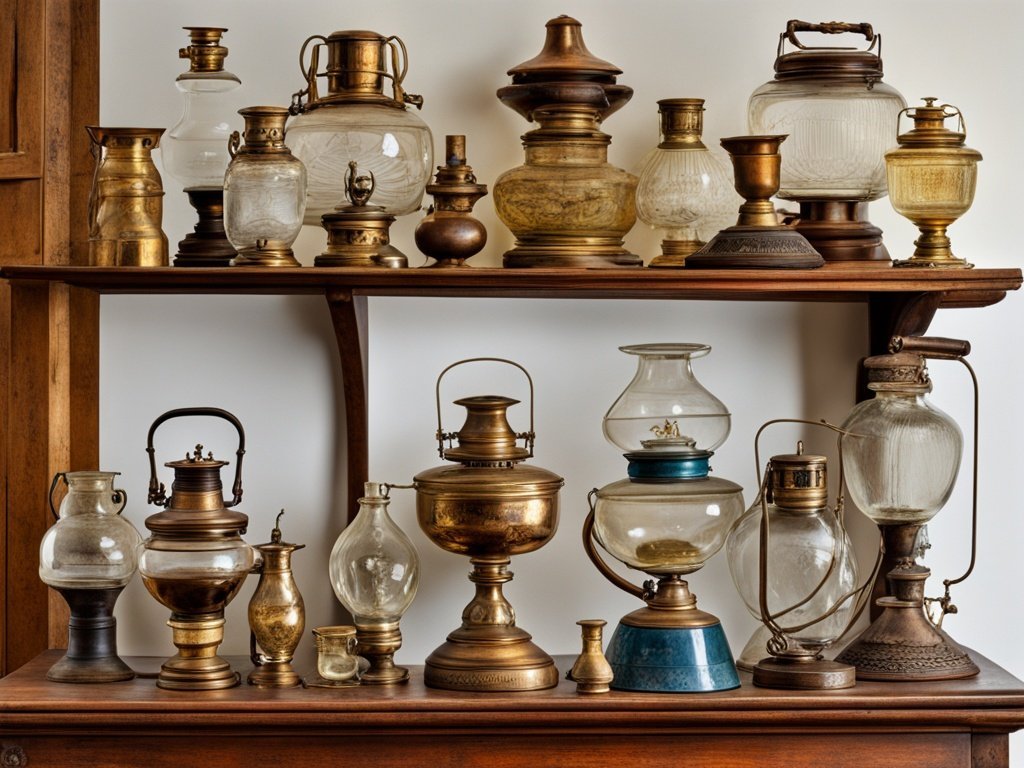
Comprehensive display of various antique oil lamps including Victorian Gone with the Wind lamp, brass student lamp, pattern glass finger lamps, and Aladdin mantle lamp

Antique Oil Lamps: Complete Collector’s Guide to Identification, Values & Care

Introduction to Antique Oil Lamps

Antique oil lamps represent more than functional lighting—they embody the craftsmanship and ingenuity of pre-electric America. From ornate Victorian parlor lamps to utilitarian farmhouse lanterns, these illuminating artifacts tell stories of daily life spanning the 18th through early 20th centuries. This comprehensive guide helps collectors and enthusiasts identify, value, authenticate, and preserve antique oil lamps in their collections.

collection of various antique oil lamps displayed on wooden shelf including Victorian parlor lamp, whale oil lamp, and Aladdin lamp
A diverse collection showcasing different styles and periods of antique oil lamps

History and Evolution of Oil Lamps

Oil lamps evolved dramatically from their earliest forms to the sophisticated designs of the late 1800s. The earliest American oil lamps burned whale oil, followed by camphene, kerosene, and eventually refined petroleum products. Each fuel type required specific burner designs, which helps modern collectors date and identify pieces accurately.

Major Historical Periods

  • Whale Oil Period (1780-1860): Simple betty lamps and early pressed glass designs
  • Camphene Era (1830-1870): Distinctive capped burners and safety features
  • Kerosene Revolution (1860-1920): Ornate Victorian designs and mass production
  • Aladdin and Mantle Lamps (1900-1930): High-efficiency designs before electrification
timeline showing evolution of antique oil lamps from whale oil betty lamp to Aladdin mantle lamp
Evolution of oil lamp technology across different fuel periods

Types of Antique Oil Lamps

Understanding the various types of antique oil lamps is essential for proper identification and valuation. Each category has distinct characteristics that affect both collectibility and market value.

Kerosene Stand Lamps

Stand lamps, also called table lamps, were the most common parlor lighting from 1860-1920. These featured decorative glass fonts (fuel reservoirs), ornate brass or metal bases, and elaborate shades. Premium examples include hand-painted Gone with the Wind lamps, banquet lamps with marble bases, and library lamps with adjustable green shades.

ornate kerosene stand lamp with hand-painted glass font and decorative brass base from Victorian era
Victorian-era Gone with the Wind lamp with hand-painted floral motif

Student Lamps

Student lamps, popular from 1870-1900, featured adjustable arms that positioned the light source over reading material. Quality student lamps were made of brass with green or white milk glass shades. Manufacturers like Bradley & Hubbard produced high-quality examples that command premium prices today.

brass student lamp with adjustable arm and green glass shade showing Bradley and Hubbard maker mark
Bradley & Hubbard brass student lamp with original green glass shade

Finger Lamps and Hand Lamps

Portable finger lamps featured handles or finger grips for carrying between rooms. These smaller lamps were produced in countless glass patterns and colors. Pattern glass finger lamps in rare colors or unusual forms are highly collectible, especially those by Sandwich Glass, Bakewell & Pears, or with coin spot or hobnail patterns.

Aladdin Lamps

Aladdin mantle lamps (1909-present) represent the peak of non-electric lamp technology, producing light equivalent to a 60-watt bulb. Model numbers, font colors, and base styles determine value. Early brass models, colored glass fonts, and rare Alacite variations are most desirable to collectors.

Identification Guide: Key Features

Proper identification requires examining multiple features including burner type, font construction, base materials, and manufacturing details. Each element provides clues to age, maker, and authenticity.

Burner Types and Dating

The burner is often the most reliable dating tool. Early whale oil burners (pre-1860) had simple wick tubes without threads. Kerosene burners featured threaded collars and adjustable flat or circular wicks. High-quality burners bear maker’s marks from companies like Miller, Plume & Atwood, or Kosmos Brenner. Mantle lamps used entirely different burner systems with fabric mantles.

Font Construction Materials

Font materials strongly influence value. Hand-blown glass fonts are generally older (pre-1870) and more valuable than pressed glass. Look for pontil marks, bubbles, and irregularities indicating hand production. Pressed glass fonts show mold seams and consistent patterns. Metal fonts in brass, copper, or tin were utilitarian but are now collectible. Milk glass, colored glass, and satin glass fonts command premium prices.

Maker's Marks and Signatures

Identifying maker’s marks significantly impacts valuation and authentication. Marks appear on burners, bases, fonts, and occasionally chimneys or shades.

Important American Manufacturers

  • Bradley & Hubbard (Meriden, CT): B&H logo on brass lamps and student lamps
  • Edward Miller & Company (Meriden, CT): Miller Lamp mark, high-quality brass and decorated lamps
  • Plume & Atwood (Waterbury, CT): P&A burner marks, premium quality
  • Pittsburgh Lamp, Brass & Glass Co.: Decorative parlor lamps
  • Aladdin Manufacturing (Multiple periods): Model numbers and Aladdin logo
  • Boston & Sandwich Glass Co.: Rare marks on early pressed glass
  • Fostoria Glass Company: F in shield mark on glass fonts

European Imports

Many oil lamps sold in America were European imports. Kosmos Brenner burners from Germany are highly regarded. French moderator lamps feature distinctive clockwork mechanisms. English Hinks & Son burners appear on quality lamps. These imports often sell for premiums due to superior craftsmanship.

Value Determination and Pricing

Antique oil lamp values range from $20 for common utilitarian pieces to $5,000+ for rare, exceptional examples. Multiple factors determine market value.

Key Value Factors

  • Rarity: Unusual colors, patterns, or forms command premiums
  • Condition: Complete, undamaged examples worth 3-5x damaged pieces
  • Maker: Documented manufacturers increase value 50-200%
  • Completeness: Original burner, chimney, and shade significantly impact price
  • Size: Larger banquet lamps often more valuable than miniatures
  • Decoration: Hand-painting, cut glass, or elaborate metalwork adds value
  • Historical significance: Documented provenance or rare models

Current Market Values (2024)

  • Common pressed glass finger lamps: $25-$75
  • Pattern glass finger lamps (good condition): $100-$300
  • Rare colored pattern glass: $300-$800
  • Gone with the Wind lamps (complete): $200-$1,500
  • Student lamps (brass, complete): $300-$800
  • Bradley & Hubbard student lamps: $500-$1,200
  • Early Aladdin lamps (common): $50-$150
  • Rare Aladdin models/colors: $300-$1,000
  • Whale oil lamps (early pressed glass): $100-$400
  • Banquet lamps (ornate, complete): $400-$2,000

Authentication Tips

The market contains numerous reproductions and marriages (authentic parts combined incorrectly). Authenticating antique oil lamps requires careful examination and knowledge of period-appropriate combinations.

Red Flags for Reproductions

  • Too-perfect glass without bubbles, waves, or irregularities
  • Modern threading on burners (too precise)
  • Shiny, new-looking brass without appropriate patina
  • Mold seams that don't align with period production methods
  • Painted decorations that feel too modern or are suspiciously perfect
  • Glass that seems too heavy or light for period production
  • Fonts and bases that don't match in age or style

Detecting Marriages

Marriages occur when dealers combine period parts from different lamps to create more valuable combinations. Check that font, base, burner, and shade all date to the same period and style. Wear patterns should be consistent across all parts. Thread sizes should match appropriately. Finish and patina should be uniform. Research documented examples in reference books to verify correct combinations.

Condition Grading System

Understanding condition grading helps buyers and sellers communicate accurately about lamp quality and establish fair pricing.

Grading Criteria

Mint/Excellent (9-10/10): No damage, all original parts, minimal wear, functions perfectly. May show very light age-appropriate patina or minor use marks. Commands full market value.

Very Good (7-8/10): Complete and original with minor wear, small flaws, or light scratches that don’t detract from display. All components function. Worth 70-90% of mint value.

Good (5-6/10): Complete but shows use, minor damage like small chips, replaced burner or chimney acceptable, functions properly. Worth 40-60% of mint value.

Fair (3-4/10): Damage visible (cracks, significant chips, heavy wear), may have incorrect/missing parts, still displays reasonably. Worth 20-30% of mint value.

Poor (1-2/10): Significant damage, major parts missing, primarily for parts or restoration projects. Worth 5-15% of mint value.

Care and Preservation Guide

Proper care preserves both value and beauty of antique oil lamps. Different materials require specific maintenance approaches.

Cleaning Glass Components

Clean glass fonts, shades, and chimneys with warm water and mild dish soap. Avoid abrasive cleaners that can scratch period glass. For stubborn kerosene residue inside fonts, use denatured alcohol followed by thorough water rinsing. Dry completely with lint-free cloths. Never use harsh chemicals on decorated, painted, or gilt glass as these damage historic finishes.

Metal Care and Polishing

Brass and copper naturally develop patina over time—this age indicator adds authenticity and value. Many collectors prefer original patina over bright polishing. If polishing is desired, use appropriate metal polish sparingly and avoid removing all patina. Never polish plated finishes as this exposes base metal. Clean painted or decorated metal with dry soft cloths only.

Storage Recommendations

  • Store in moderate temperature and humidity (avoid extremes)
  • Keep away from direct sunlight to prevent paint fading
  • Wrap glass components separately in acid-free tissue
  • Store chimneys and shades vertically to prevent warping
  • Remove fuel and wicks from lamps in long-term storage
  • Keep metal and glass components separate to avoid contact damage
  • Document all parts with photos if storing disassembled

Display and Safety

Display antique oil lamps on stable surfaces away from traffic areas. If burning lamps, use only proper fuel (kerosene or lamp oil), never gasoline or other volatile fuels. Ensure adequate ventilation. Check chimneys for cracks before lighting as these can shatter from heat. Never leave burning lamps unattended. Many collectors display lamps without burning them to preserve condition.

Building a Collection

Starting an antique oil lamp collection requires research, patience, and strategic acquisition. Successful collectors develop expertise in specific categories rather than collecting randomly.

Collection Strategies

  • Focus on one type (student lamps, finger lamps, Aladdins) for deeper expertise
  • Collect by manufacturer to build comprehensive brand representation
  • Specialize in specific glass patterns or colors
  • Focus on one historical period for cohesive display
  • Collect miniature lamps if space is limited
  • Build a study collection showing lamp evolution
  • Focus on lamps from a specific region or state

Where to Buy

Antique oil lamps are available through multiple channels. Estate sales often yield bargains as families liquidate collections. Antique shops provide vetted inventory with some seller accountability. Specialized lamp shows connect serious collectors with quality pieces. Online auctions expand access but require careful authentication skills. Collector clubs offer trading opportunities and access to knowledgeable members.

Resources for Collectors

  • Night Light (ALADDIN publication for Aladdin collectors)
  • Rushlight Club (general antique lighting collectors)
  • Price guides by J.W. Courter, Catherine Thuro, and Tom Johnson
  • Online forums and Facebook collector groups
  • Museum collections for research (Sandwich Glass Museum, etc.)
  • Local antique lamp and lighting collectors clubs

Frequently Asked Questions

How do I determine the age of my antique oil lamp?

Age determination relies on multiple factors: burner type (whale oil, camphene, or kerosene indicates different periods), glass manufacturing techniques (hand-blown vs. pressed), maker’s marks when present, and overall style characteristics. Whale oil lamps date pre-1860, camphene lamps from 1830-1870, kerosene lamps from 1860-1920, and Aladdin mantle lamps from 1909 onward. Consulting reference books with documented examples provides the most reliable dating.

What are the most valuable antique oil lamps?

The most valuable antique oil lamps include rare pattern glass finger lamps in unusual colors ($500-$2,000), exceptional Gone with the Wind lamps with original hand-painted decoration ($1,000-$5,000), high-quality Bradley & Hubbard student lamps ($500-$1,200), rare early Aladdin models ($500-$1,500), and documented pieces with exceptional provenance. Completeness, condition, and rarity drive highest values.

How can I tell if my oil lamp is a reproduction?

Reproductions typically show overly uniform glass without period manufacturing irregularities, modern precision threading on burners, suspiciously perfect painted decoration, and lack appropriate patina on metal components. Authentic antique lamps show subtle bubbles in glass, slight manufacturing variations, age-appropriate wear patterns, and period-correct construction methods. When in doubt, consult experienced collectors or appraisers with reference materials.

Is it safe to burn antique oil lamps?

Burning antique oil lamps is possible but requires precautions. Use only proper lamp oil or kerosene, never gasoline. Inspect chimneys for cracks before lighting. Ensure adequate ventilation as lamps consume oxygen and produce carbon monoxide. Never leave burning lamps unattended. Many collectors choose not to burn valuable lamps to preserve condition, instead displaying them as decorative art objects.

What's the difference between a hurricane lamp and a student lamp?

Hurricane lamps feature simple tubular glass chimneys that protect the flame from wind, making them portable and utilitarian. Student lamps are stationary table lamps with adjustable arms, designed for focused task lighting while reading or studying, typically featuring horizontal font positions and higher-quality construction. Student lamps generally command higher collector prices due to superior craftsmanship and desirability.

Conclusion

Antique oil lamps offer collectors a tangible connection to pre-electric life while providing beautiful decorative objects. Success in collecting requires developing expertise in identification, understanding value factors, learning authentication skills, and practicing proper care. Whether focusing on ornate Victorian parlor lamps, practical Aladdin models, or colorful pattern glass finger lamps, the field offers collecting opportunities for every interest level and budget. Building knowledge through research, joining collector communities, and examining many examples develops the expertise needed to assemble a meaningful collection that preserves these luminous artifacts of American history.