
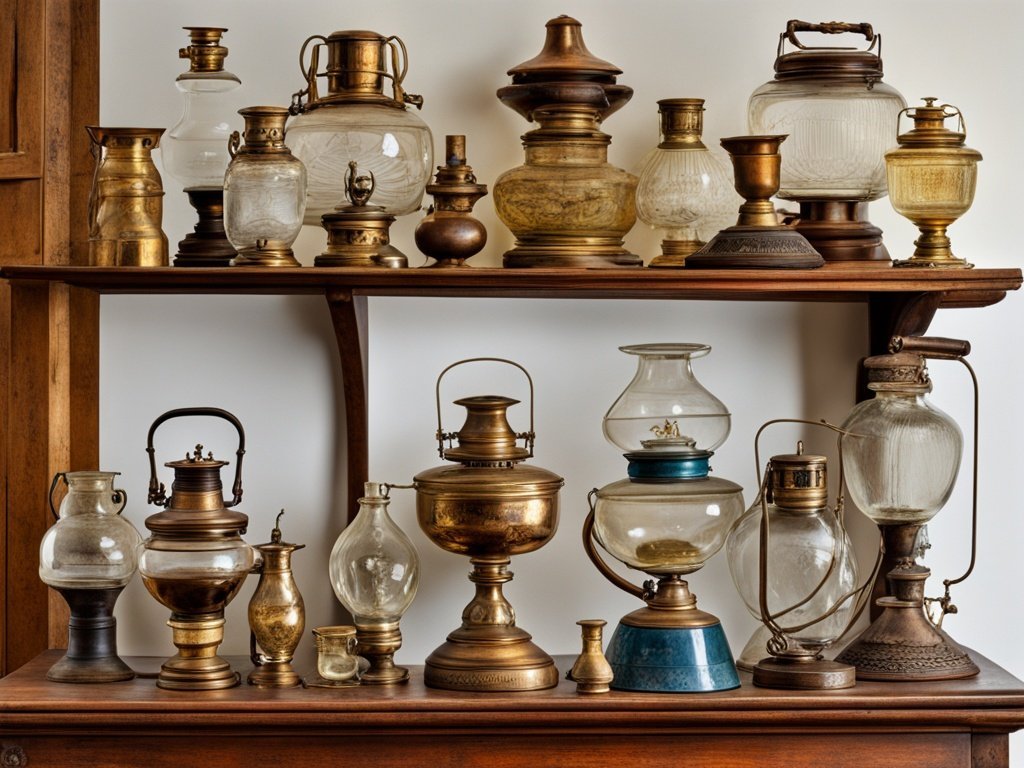
Antique oil lamps are among the most widely collected antique lighting artifacts in America. Produced from the early 1800s through the early twentieth century, they range from humble tin kerosene lamps worth a few dollars to elaborate Gone with the Wind parlor lamps worth thousands. This guide covers every major type of antique oil lamp, how to identify them by burner, base, and maker, and what they’re worth today.
Antique Oil Lamp Price Guide: Quick Reference
| Lamp Type | Era | Average Price Range | Highest Values |
|---|---|---|---|
| Whale oil lamp | 1800–1860 | $75–$350 | $600+ (art glass, pairs) |
| Burning fluid lamp | 1830–1865 | $50–$250 | $500 (rare forms, pairs) |
| Flat-wick kerosene, clear glass | 1860–1920 | $15–$75 | $200 (colored, decorated) |
| Rayo center-draft lamp | 1880–1920 | $45–$150 | $300 (nickel, original shade) |
| Bradley & Hubbard lamp | 1875–1920 | $75–$350 | $800+ (hanging, art glass shade) |
| Gone with the Wind parlor lamp | 1880–1910 | $150–$800 | $2,000+ (signed painting) |
| Miniature oil lamp | 1870–1910 | $25–$250 | $600+ (art glass, figural) |
| Student lamp, single arm | 1870–1910 | $75–$200 | $400 (brass, double arm) |
| Aladdin mantle lamp (common models) | 1908–1960s | $35–$150 | $600+ (Model A, colored glass) |
| Brass kerosene lamp | 1870–1920 | $30–$120 | $300 (elaborate casting, complete) |
A Brief History of Antique Oil Lamps
The development of antique oil lamps spans roughly a century of American domestic life, from the whale oil era through the arrival of electric lighting:
- Before 1830 — Whale oil lamps: The earliest American oil lamps burned whale oil, which produced a cleaner flame than tallow candles. Whale oil lamps have a distinctive double-tube burner designed for the thick oil. Production peaked in the 1820s–1840s before whale populations declined and oil became expensive.
- 1830s–1860s — Lard oil and burning fluid: As whale oil became scarce, lamps were adapted for lard oil (rendered pork fat) and highly flammable “burning fluid” — a mixture of turpentine and alcohol. Burning fluid lamps have a distinctive elongated burner with two angled tubes to keep the flame away from the volatile fuel.
- 1850s–1860s — Kerosene arrives: The commercial refining of kerosene (rock oil) beginning in the 1850s transformed artificial lighting. Kerosene burned more cleanly and safely than earlier fuels, and the demand for kerosene lamps exploded. This era saw the development of the flat-wick burner that defined oil lamp design for the next 50 years.
- 1860s–1900s — The golden age: The post-Civil War decades represent the peak of antique oil lamp production. American glasshouses (including Consolidated, Mt. Washington, and many others) produced thousands of lamp styles. Hand-painted parlor lamps, elaborate “Gone with the Wind” ball lamps, miniature night lamps, and utilitarian kerosene lamps were all produced in this period.
- 1900s–1930s — Aladdin and the mantle lamp: The introduction of the incandescent mantle burner (first by Aladdin in 1908) dramatically improved oil lamp output. Aladdin mantle lamps produce a bright white light rivaling early electric bulbs and were popular in rural areas without electricity through the 1940s.
- After 1930 — Decline: Rural electrification through the 1930s and 1940s ended practical oil lamp use in most American homes. Lamps made after this point were primarily decorative.
Antique Oil Lamp Types: Identification Chart
Whale Oil Lamps (1800–1860)
Whale oil lamps are identified by their distinctive double-tube cork burner. The two small tubes (typically 3/16″ to 1/4″ diameter) extend from a cork or pewter cap and hold two small wicks side by side. The font (reservoir) is typically pewter, tin, or pressed glass with a narrow neck. Glass whale oil fonts are often heavy lead glass with a small, round opening. The base may be pewter, tin, or glass. Whale oil lamps were not designed to burn kerosene — the wick tubes are too narrow for the wider flat wicks kerosene burners require.
Identifying features of whale oil lamps:
- Two-tube cork burner (pewter or brass)
- Small narrow font opening (to limit vapor escape)
- Heavy pressed or blown glass font if glass (pre-1860s glass is typically lead crystal)
- Pewter, tin, or early pressed glass construction
- No chimney (whale oil lamps predate the standard lamp chimney)
Values: Whale oil lamps in original, complete condition with intact pewter burner: $75–$350+ depending on form. Elaborate blown glass fonts or unusual colors: $200–$600. Pairs command a premium.
Burning Fluid Lamps (1830–1865)
Burning fluid lamps are identified by their two angled wick tubes, which splay outward at an angle to keep the flame away from the fuel reservoir. The fuel (a volatile turpentine-alcohol blend called “camphene” or “burning fluid”) required this safety design because it was highly flammable. Burning fluid lamps must never be used with modern kerosene — the open tubes make them dangerous with any fuel.
Identifying features:
- Two angled wick tubes (not vertical like whale oil)
- Wider font opening than whale oil lamps
- Cap fits snugly to seal the volatile fuel when not in use
- Typically glass or brass construction
Values: $50–$250 depending on condition and materials. Pairs: $150–$500.
Flat-Wick Kerosene Lamps (1860–1920)
The standard kerosene oil lamp uses a flat cotton wick, typically 5/8″ to 1″ wide, that draws fuel up from the font by capillary action. The wick is raised and lowered with a small knob on the burner. Above the burner sits a glass chimney, and above that (on more elaborate lamps) a glass shade. This basic design dominated American oil lamp production from the Civil War era through World War I.
Common flat-wick burner makers:
- Duplex / Eagle: Standard single-wick burner; found on thousands of common kerosene lamps
- Rayo: A premium center-draft burner (see below) also made flat-wick versions
- P&A (Plume & Atwood): One of the largest burner manufacturers; marked “P&A” on the collar
- Royal: Another common burner marking found on kerosene lamps
- Corona: High-quality burners on better-grade parlor lamps
Values: Common flat-wick kerosene lamps in clear glass: $15–$75. Colored glass fonts: $35–$150. Elaborate pressed or pattern glass: $50–$250.
Center-Draft Kerosene Lamps (1880–1930)
Center-draft lamps are a significant improvement over flat-wick designs. Instead of a flat wick, they use a circular wick and a central draft tube that draws air up through the center of the flame for more complete combustion and brighter light. The most famous center-draft lamps are the Rayo, the B&H (Bradley & Hubbard), and the Aladdin non-mantle models.
Identifying features of center-draft lamps:
- Round (not flat) wick visible in the burner
- Central draft tube visible inside the burner collar
- Typically a larger, more elaborate base than flat-wick lamps
- Maker name often stamped on the burner: “RAYO,” “B&H,” “MILLER,” “MANHATTAN BRASS”
Values: Rayo center-draft table lamp (common), complete: $45–$120. B&H hanging center-draft lamp, complete: $75–$250. Miller center-draft table lamp: $55–$150.
Gone with the Wind (GWTW) Lamps (1880–1910)
The “Gone with the Wind” lamp is a style name (popularized after the 1939 film) for an elaborate Victorian parlor lamp characterized by a large ball-shaped glass shade mounted atop a matching ball-shaped glass font, both mounted on a decorative brass or cast-iron base. The shade and font are typically hand-painted with florals, berries, or scenic designs — or decorated with raised enamel (coralene) or applied glass decoration.
Identifying features of GWTW lamps:
- Large ball-shaped shade (typically 10″–14″ diameter) matching the ball-shaped font
- Hand-painted or enamel decoration on both shade and font
- Ornate cast-metal base (brass, spelter, or cast iron)
- Flat-wick or center-draft burner
Major makers of GWTW-style lamps include Consolidated Lamp & Glass, Hobbs Brockunier, and many smaller glasshouses. Most are unsigned. Authentication focuses on the quality of the painting, the clarity and weight of the glass, and the overall symmetry of the matched shade and font.
Values: Matched GWTW lamp sets (font and shade decorated en suite), working condition: $150–$800. Exceptional painting or unusual colors: $500–$2,000+. Reproduction GWTW lamps (made after 1960) are worth $25–$75.
Miniature Oil Lamps (1870–1910)
Miniature oil lamps (also called “night lamps” or “fairy lamps”) are small kerosene or burning-fluid lamps typically 3″–8″ tall, designed as nightlights or decorative accent pieces. They were produced in enormous variety in pressed glass, art glass, and painted milk glass. Major pressed-glass miniature lamp makers include Atterbury, Consolidated, and dozens of pattern glass companies.
The most desirable miniature lamps are in rare colors (blue, green, amber, amethyst) or unusual art glass (satin glass, burmese, peachblow). Clear glass miniatures are the most common and least valuable.
Values: Clear pressed glass miniature lamps: $25–$75. Colored pressed glass: $75–$200. Art glass miniatures (satin, burmese, cased glass): $100–$600+.
Student Lamps (1870–1910)
Student lamps (also called “Argand student lamps”) are adjustable desk lamps with a side-mounted oil font positioned above the burner level, so the fuel flows down to the wick by gravity rather than capillary action. This design allows the font to be positioned out of the direct line of sight and allows the lamp to be adjusted up and down. Student lamps produce a very bright, steady light and were favored for reading and study.
Common student lamp makers:
- Manhattan Brass Company: One of the most common American student lamp makers; many are marked “MANHATTAN BRASS” on the font collar
- B&H (Bradley & Hubbard): Produced high-quality student lamps, often with ornate bases
- Miller: Edward Miller & Co. was another major student lamp maker
Values: Complete student lamp (single-arm) in working condition: $75–$200. Double-arm student lamp: $150–$350. Nickel-plated or brass with original shade: $100–$300.
Aladdin Mantle Lamps (1908–present)
Aladdin lamps are not kerosene lamps in the traditional sense — they use a circular cotton mantle that glows incandescently when heated by the flame of the vapor from kerosene or lamp oil. The Aladdin mantle produces a bright white light (equivalent to a 60-watt incandescent bulb) that far exceeds what a wick lamp can achieve. Aladdin lamp models are identified by their “Model” designation (Model A through Model 23C), which can be found on the burner or in catalogs.
Aladdin lamp collecting is a specialized hobby with a dedicated collector base. Model designations and condition are the primary value determinants. Early models (A through B) are rarest and most valuable. Later production models are more commonly found.
Values:
- Aladdin Model A (1908–1909): $200–$600+
- Aladdin Model B (1909–1912): $150–$400
- Aladdin Model 6 (1916–1928): $45–$120
- Aladdin Model 12 (1928–1935): $35–$90
- Aladdin Model 23 (1994–present, reproduction): $30–$60
- Aladdin table lamp with original original colored glass shade: $75–$300
- Aladdin kerosene hanging lamp (complete, with original shade): $100–$350
Antique Oil Lamp Burner Identification Chart
| Burner Type | Era | Identifying Feature | Fuel Used |
|---|---|---|---|
| Whale oil / double-tube | 1800–1860 | Two small vertical tubes from cork or pewter cap | Whale oil, lard oil |
| Burning fluid / camphene | 1830–1865 | Two angled outward-splayed tubes | Burning fluid (turpentine-alcohol mix) |
| Flat-wick kerosene (No. 0–3) | 1860–1920 | Flat wick, adjustable knob, threaded collar | Kerosene |
| Center-draft (Rayo / B&H) | 1880–1930 | Round wick, central air tube visible, larger burner | Kerosene |
| Aladdin mantle burner | 1908–present | Round wick with gallery for incandescent mantle | Kerosene or lamp oil |
| Gone with the Wind (flat-wick) | 1880–1910 | Standard flat-wick in ornate collar under ball shade | Kerosene |
| Miniature / night lamp burner | 1870–1910 | Very small flat-wick, often only 3/8″–5/8″ wide | Kerosene |
| Student lamp gravity burner | 1870–1910 | Side-mounted font above burner level; gravity feed | Kerosene |
Antique Oil Lamp Maker Marks
Most antique oil lamps are not signed by their glass manufacturer, but the burner hardware often carries the maker’s mark. Look on the burner collar (the ring that screws onto the font) or on the base of the burner for these marks:
| Mark on Burner | Company | Location | Active Era | Lamp Type |
|---|---|---|---|---|
| RAYO | Rayo Inc. (Standard Oil division) | Indiana | 1890–1930 | Center-draft table lamps |
| B&H / BRADLEY & HUBBARD | Bradley & Hubbard Mfg. Co. | Meriden, CT | 1854–1940 | Center-draft and hanging lamps |
| E. MILLER / MILLER | Edward Miller & Co. | Meriden, CT | 1857–1920 | Kerosene and student lamps |
| MANHATTAN BRASS | Manhattan Brass Co. | New York, NY | 1870–1910 | Student lamps (primary maker) |
| P&A / PLUME & ATWOOD | Plume & Atwood Mfg. Co. | Waterbury, CT | 1850–1920 | Flat-wick burners (all lamp types) |
| ALADDIN | Mantle Lamp Company of America | Chicago, IL | 1908–present | Mantle lamps (model # on burner) |
| SAFETY LAMP CO. | Various manufacturers | USA | 1880–1910 | Kerosene safety lamps |
Glass lamp fonts and shades were made by separate glasshouses that rarely marked their work. Attribution of glass lamp fonts relies on pattern identification, color, and comparison to known manufacturer catalogs.
How to Date Antique Oil Lamps
Dating antique oil lamps involves looking at several features:
| Dating Feature | Date Range | Lamp Type |
|---|---|---|
| Double-tube cork or pewter burner | 1800–1860 | Whale oil lamp |
| Two angled outward-splayed wick tubes | 1830–1865 | Burning fluid / camphene lamp |
| Flat-wick kerosene burner with chimney | Post-1860 (peak 1870–1920) | Standard kerosene lamp |
| Round wick with central draft tube | 1880–1930 | Center-draft (Rayo, B&H, Miller) |
| Mantle gallery above round wick burner | 1908–present | Aladdin mantle lamp |
| Pewter hardware | Pre-1870 | Whale oil / burning fluid era |
| Heavy lead glass (clear ring when tapped) | Pre-1880s | Early glass fonts |
| Brilliant cut and etched glass | 1880–1915 | Victorian parlor lamps |
| Depression glass colors (pink, green, amber) | 1920s–1930s | Late-production kerosene lamps |
| Spelter or cast-iron ornate base | 1880–1910 | GWTW and Victorian parlor lamps |
| Nickel-plated hardware | 1890–1930 | Center-draft era lamps |
By Fuel Type
The burner design tells you what fuel the lamp was made for, which narrows the date range significantly:
- Whale oil / double-tube burner: pre-1860
- Burning fluid / angled tubes: 1830–1865
- Flat-wick kerosene: post-1860 (most likely 1870–1920)
- Aladdin mantle burner: 1908 or later (check model number)
By Glass Type
- Heavy lead glass with pronounced ring when tapped: pre-1880s (lead glass dominates)
- Lime glass (lighter, no ring): post-1864 when lime-soda glass production ramped up
- Brilliant cutting and etching at their finest: 1880–1915
- Depression glass colors (pink, green, amber): 1920s–1930s
By Base and Hardware
- Pewter hardware: typically pre-1870
- Brass hardware with simple design: 1860–1890
- Cast-iron or spelter (zinc alloy) ornate bases: 1880–1910
- Nickel-plated hardware: 1890–1930
Antique Oil Lamp Values by Type
| Type | Condition | Value Range |
|---|---|---|
| Common kerosene lamp, clear glass | Good, complete | $15–$50 |
| Kerosene lamp, colored glass font | Good, complete | $35–$150 |
| Whale oil lamp, pewter/glass | Good, original burner | $75–$350 |
| Burning fluid lamp | Good, original burner | $50–$250 |
| Gone with the Wind parlor lamp (matched set) | Good, original shade and font | $150–$800 |
| Gone with the Wind lamp, exceptional painting | Excellent | $500–$2,000+ |
| Miniature lamp, clear pressed glass | Good | $25–$75 |
| Miniature lamp, colored pressed glass | Good | $75–$200 |
| Miniature lamp, art glass (satin/burmese) | Good | $100–$600+ |
| Student lamp, single arm | Complete, working | $75–$200 |
| Student lamp, double arm | Complete, working | $150–$350 |
| Rayo center-draft table lamp | Complete, working | $45–$120 |
| B&H center-draft hanging lamp | Complete, original shade | $75–$250 |
| Aladdin Model A (earliest) | Good to excellent | $200–$600+ |
| Aladdin Model 6–12 (common) | Good | $35–$120 |
Aladdin Lamp Values by Model Number
Aladdin manufactured mantle oil lamps from 1908 through the 1960s. Model numbers run roughly in chronological order — lower numbers are older and generally more valuable. Color matters more than any other factor: white, clear, and green are common; ruby, cobalt, and rose are rare and command large premiums.
| Aladdin Model | Years Produced | Clear / White Glass | Colored Glass | Notes |
|---|---|---|---|---|
| Model A (earliest) | 1908–1910 | $200–$400 | $400–$700 | Rarest model; burner marked “A” |
| Model B | 1910–1912 | $150–$350 | $350–$600 | Early production; hard to find complete |
| Model 1–3 | 1912–1916 | $75–$200 | $200–$450 | Transitional; burner style changed |
| Model 6 | 1916–1920 | $45–$120 | $150–$350 | First mass-market model |
| Model 7 | 1920–1923 | $35–$100 | $120–$300 | Improved burner design |
| Model 8 | 1923–1928 | $30–$90 | $100–$250 | Most common single model |
| Model 11 Corinthian (clear) | 1936–1937 | $35–$85 | $250–$600 (ruby/cobalt) | Ruby and cobalt among most sought |
| Model 12 Venetian (clear) | 1937–1939 | $35–$80 | $200–$500 | Peach Venetian also sought |
| Model 23 Simplicity | 1949–1955 | $25–$65 | $80–$200 | Post-WWII; very common |
| Any model, table shade | Various | add $50–$150 | add $100–$300 | Original parchment or glass shade adds premium |
Rayo Center-Draft Lamp Values
Rayo was the brand name used by Standard Oil for center-draft kerosene lamps sold from roughly 1898 through the 1920s. Rayo lamps are among the most common antique oil lamps and are widely available. Value depends heavily on finish, completeness of the original shade, and whether the chimney is intact.
| Rayo Lamp Style | Finish | Condition | Value Range |
|---|---|---|---|
| Standard table lamp, no shade | Nickel | Good, with chimney | $35–$75 |
| Standard table lamp with original shade | Nickel | Good | $65–$150 |
| Rayo Junior (smaller size) | Nickel | Good | $45–$100 |
| Rayo table lamp, polished brass | Brass | Good, with chimney | $55–$130 |
| Rayo hanging lamp | Nickel or brass | Complete with shade | $75–$200 |
| Rayo with fancy art glass shade | Nickel or brass | Good | $150–$350 |
| Rayo with original box and paperwork | Any | Excellent | $200–$400 |
Bradley & Hubbard (B&H) Lamp Values
Bradley & Hubbard of Meriden, Connecticut manufactured high-quality oil lamps and lighting hardware from 1854 through the early 20th century. B&H lamps are identified by a raised “B&H” mark on the burner collar. Their cast-metal bases and high-quality art glass shades make them among the most collectible antique lamp manufacturers.
| B&H Lamp Type | Shade Type | Condition | Value Range |
|---|---|---|---|
| Table lamp, cast iron base | No shade | Good, with chimney | $45–$120 |
| Table lamp, cast iron base | Original opal glass shade | Good | $100–$250 |
| Table lamp, brass/nickel base | Original art glass shade | Good | $150–$450 |
| Hanging library lamp | No shade | Good, complete hardware | $75–$200 |
| Hanging library lamp | Original milk glass dome shade | Good | $150–$400 |
| Hanging lamp with slag glass shade | Slag glass panel shade | Good | $250–$800 |
| B&H piano lamp (tall floor style) | Original shade | Good to excellent | $300–$900 |
| Documented B&H catalog piece, rare form | Original matched shade | Excellent | $800–$2,000+ |
Antique Miniature Oil Lamp Values by Type
Miniature oil lamps (night lamps, fairy lamps) were produced from the 1870s through the early 1900s. They stand 3 to 8 inches tall and burned kerosene, whale oil, or burning fluid in very small quantities. The most collectible are figured or art glass examples. The “Nutmeg” burner (made by Plume & Atwood) is the most common miniature burner and helps identify authentic period lamps.
| Miniature Lamp Type | Glass Type | Condition | Value Range |
|---|---|---|---|
| Pressed glass, clear | Clear pressed glass | Good, complete | $25–$60 |
| Pressed glass, colored | Amber, blue, green glass | Good, complete | $60–$175 |
| Milk glass, plain white | Milk glass | Good, complete | $40–$100 |
| Milk glass, painted or decorated | Milk glass with hand painting | Good, complete | $75–$200 |
| Satin glass (matte finish) | Satin glass | Good, complete | $100–$350 |
| Burmese glass (shaded yellow-pink) | Mt. Washington burmese | Good, complete | $200–$600 |
| Peachblow glass | Art glass | Good, complete | $200–$500 |
| Figural (Santa, animal, novelty form) | Any glass | Good, complete | $150–$700 |
| Nutmeg burner, marked P&A | Any | Burner intact, complete | add $15–$40 premium |
Antique Brass Burner Kerosene Lamp Values
Brass-fount and brass-collar kerosene lamps represent the mid-to-upper tier of everyday antique oil lamps. The brass components resist corrosion better than tin or zinc, and intact original patina (rather than heavy polish) is preferred by collectors. The burner maker’s name is stamped on the brass collar and helps date the lamp.
| Lamp Style | Burner / Maker | Condition | Value Range |
|---|---|---|---|
| Brass finger lamp (handled) | Flat-wick, unmarked | Good, with chimney | $30–$80 |
| Brass finger lamp | P&A (Plume & Atwood) | Good, with chimney | $45–$110 |
| Brass table lamp, plain font | Flat-wick, collar burner | Good, with chimney | $35–$90 |
| Brass table lamp, cast decorative base | Flat-wick | Good, with chimney | $60–$175 |
| Brass table lamp with glass font insert | Flat-wick | Good, font intact | $55–$160 |
| Brass banquet lamp (tall pedestal) | Center-draft | Good, complete | $100–$300 |
| Brass parlor lamp with painted glass shade | Flat-wick or center-draft | Good, complete | $150–$450 |
| Antique brass lamp, hallmarked or maker-attributed | Known maker | Excellent, provenance | $300–$900+ |
What Makes Antique Oil Lamps More Valuable
- Completeness: A lamp with its original chimney, shade, and burner is worth 2–4× a lamp missing any component. The chimney is the piece most often broken or lost.
- Original color: Colored glass fonts (blue, green, amber, cranberry, amethyst) are worth 2–5× the same form in clear glass.
- Hand-painted decoration: Signed or attributed hand painting by documented decorators adds significant value, particularly on parlor lamps.
- Art glass: Fonts in satin glass, burmese, peachblow, or other Victorian art glass techniques are at the top of the value spectrum.
- Pairs: Matched pairs of candlestick-form lamps or student lamps command a 30–80% premium over single examples.
- Early fuel types: Whale oil and burning fluid lamps are rarer than kerosene lamps and command higher prices for equivalent quality.
- Maker attribution: Lamps attributable to documented makers (Mt. Washington Glass, Hobbs Brockunier, Consolidated Lamp) sell at premiums when the attribution is solid.
Frequently Asked Questions
How do I identify what type of antique oil lamp I have?
Start with the burner. Two small vertical tubes from a cork or pewter cap = whale oil lamp (pre-1860). Two outward-angled tubes = burning fluid lamp (1830–1865). A flat wick with a threaded collar and chimney = kerosene lamp (post-1860). A round wick with a central draft tube = center-draft kerosene lamp (Rayo, B&H, 1880–1930). A mantle gallery above the burner = Aladdin lamp (post-1908). The burner is often stamped with the maker’s name, which helps narrow the date and type further.
How can I tell if a Gone with the Wind lamp is antique or a reproduction?
Several tests distinguish antique GWTW lamps from reproductions. First, check the weight and glass quality: antique Victorian glass is typically heavier and has a slightly different texture than modern imports. Second, examine the painting: antique hand painting shows brushwork variation and aging, while reproduction decals look flat and uniform under magnification. Third, check the hardware: antique bases are often cast iron or brass with patina; reproduction bases are frequently lightweight pot metal with a thin finish. Fourth, check the fit: on antique lamps, the shade and font were matched at the factory; on reproductions, they often have an imprecise fit. Finally, check the burner: antique GWTW lamps use period flat-wick burners (often stamped P&A or similar); reproduction lamps often have modern brass or chrome fittings.
What is an antique oil lamp worth?
Antique oil lamp values range from $15 (common clear-glass kerosene lamp) to $2,000+ (exceptional Gone with the Wind parlor lamp with matched hand-painted font and shade). Typical ranges: clear glass kerosene lamps $15–$75; colored glass lamps $35–$200; miniature night lamps $25–$200; whale oil lamps $75–$350; student lamps $75–$350; center-draft Rayo or B&H lamps $45–$250; Gone with the Wind lamps $150–$800 (exceptional examples higher). Completeness, original color, art glass decoration, and maker attribution are the key value drivers.
Can I still use an antique oil lamp?
Kerosene, Aladdin, and center-draft lamps from the late 1800s through early 1900s can generally still be used safely if the wick, chimney, and burner are in good condition. Use only modern lamp oil or clear kerosene (not dyed kerosene). Never use a whale oil or burning fluid lamp with kerosene — the burner design is not compatible and can be dangerous. Replace any cracked chimney before use. Aladdin mantle lamps require a new mantle for each use; replacement mantles are still sold by the Aladdin company. Art glass or hand-painted shades should not be used near open flame — their collector value is too high to risk damage.
What do antique oil lamp burner numbers mean?
Flat-wick kerosene burners are sized by number (No. 0, No. 1, No. 2, No. 3) which refers to the width of the wick and the diameter of the burner collar. No. 0 (very small, 3/8″ wick) fits miniature lamps. No. 1 (5/8″ wick) is the most common household lamp burner. No. 2 (7/8″ wick) produces more light and fits larger fonts. No. 3 (1″ wick) is the largest flat-wick standard burner. These numbers also determine chimney size: a No. 1 burner requires a No. 1 chimney. Mismatching burner and chimney numbers is a common mistake when replacing chimneys on antique lamps.
How do I identify an Aladdin lamp model?
Aladdin lamp models are identified by the letter or number stamped on the burner or gallery — look for “MODEL A,” “MODEL 6,” “MODEL 12,” “MODEL 23,” etc. The model number determines which mantle, chimney, and wick are compatible replacements. Models A through C (1908–1914) are the earliest and rarest. Models 6 through 12 (1916–1935) are the most commonly found. Models 21 through 23 (1937–present) represent the modern era. The Aladdin Collectors & Dealers Association publishes a complete model guide with production dates and values.
What are the most valuable antique oil lamps?
The most valuable antique oil lamps are Gone with the Wind parlor lamps with matched hand-painted font and shade sets, typically $500–$2,000+. Exceptional examples with documented glasshouse attribution (Mt. Washington Glass, Hobbs Brockunier) or unusual art glass treatments (satin glass, burmese, peachblow) can reach $3,000–$8,000 at specialty auctions. Art glass miniature lamps sell for $100–$600+. Whale oil lamps with original complete pewter hardware fetch $75–$350. Early B&H center-draft hanging lamps with original shades in excellent condition command $150–$400+.
Where can I find antique oil lamps for sale at fair prices?
The best sources for antique oil lamps are estate sales and estate auctions, where generalist pricers often undervalue specialized Victorian oil lamps. eBay completed sales provide the most reliable current market values for any specific type. Dedicated antique lighting dealers and regional antique shows in New England and the Midwest offer the largest concentrations of Victorian oil lamps. For Aladdin mantle lamps specifically, the Aladdin Mantle Lamp Co. still sells replacement parts and Aladdin collector groups hold annual conventions. Avoid buying incomplete lamps unless the price accounts for the cost of period-correct replacement parts.